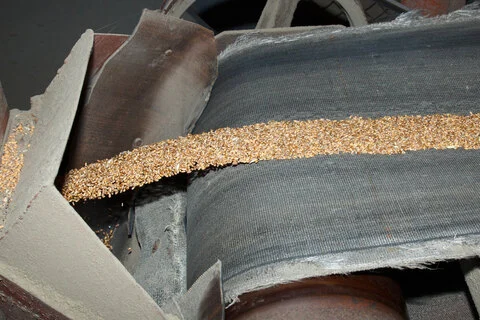
Textile conveyor belt standards address the additional tests that conveyor belts with a textile composition undergo. Flammability, tear propagation, tensile strength, and dimensional tests are included. Additionally, specifications for rubber or plastics covered belts of textile construction are given, addressing both general and underground mining, anticipating the range of environments conveyor belts with a textile carcass will be used in.
ISO 16851:2012 specifies a method for determining the net length of an endless (spliced) conveyor belt. It applies to all types of construction of conveyor belting with the exception of belts containing steel cord reinforcement. It is not suitable or valid for light conveyor belts described in ISO 21183-1.
This document specifies a test method for the determination of the full thickness tensile strength in the longitudinal direction and the elongation at the reference force and breaking point of conveyor belts having a textile carcass. The method can also be used for the determination of full thickness tensile strength in the transverse direction and the elongation at the breaking point, for use when the manufacturer is requested by the purchaser to state values for these properties. This document does not apply to light conveyor belts as described in ISO 21183 1 .
ISO 14890:2013 specifies requirements for rubber and/or plastics covered conveyor belting of textile construction for general surface use on flat or troughed idlers. ISO 14890:2013 is not suitable or valid for light conveyor belts as described in ISO 21183-1. Items that are not requirements of ISO 14890:2013, but need to be agreed between the manufacturer and the purchaser, as well as a list of the details intended to be supplied by the purchaser of belting with an enquiry are included in the annexes.
This document specifies requirements for rubber- or plastics-covered conveyor belting of textile construction for use in underground mines and disposed on flat or troughed idlers. It is not applicable to light conveyor belts as described in ISO 21183-1. This document does not include requirements for plastics covers. These are agreed upon by the manufacturer and purchaser, taking into account the type of plastics to be used. Related items that are not requirements of this document, but which it is recommended be agreed upon by the manufacturer and purchaser, are included in Annex A. Details recommended to be supplied by the purchaser of belting with an enquiry are given in Annex B. The ability of a belt to run straight cannot be assessed until the belt is installed. Requirements for this are, therefore, outside the scope of this document; nevertheless, recommendations for lateral drift are given in Annex C. Attention is drawn to local regulations for safety which might be in place where the belts are to be used.
This document specifies the widths and lengths of conveyor belts with a textile carcass. It also specifies the corresponding tolerances. It is not applicable to light conveyor belts as described in ISO 21183-1, as tolerances on the widths and lengths of cut light conveyor belts are given in ISO 15147. NOTE The lengths of conveyor belts are not standardized.
This document specifies a method for assessing, on a small scale, the reaction of a conveyor belt to an ignition flame source. It is applicable to conveyor belts having a textile carcass as well as steel cord conveyor belts.
Describes fixed and automatic take-up devices. Contains recommendations for adjustment values which are valid for the most commonly used belts. Tabulates various types of take-up devices with relation to conveyor lengths from 0 to 12 m up to 150 to 300 m. For belts with a fabric carcase whose length exceeds 300 m and belts with a metal carcase of any length, the manufacturer should justify the chosen adjustment.
This document specifies a method of test for the measurement of the propagation resistance of an initial tear in textile conveyor belts, either in full thickness or of the carcass only. This document is applicable to textile belts in installations where there is a risk of longitudinal tearing.
This document specifies test methods for the determination of total belt thickness and the thickness of constitutive elements of conveyor belts having a textile carcass. The constitutive elements include the covers, the carcass and interlayers, i.e. the material between adjoining plies. This document does not apply to light conveyor belts as described in ISO 21183 1 .