Historical
ASTM E1251-04
Standard Test Method for Optical Emission Spectrometric Analysis of Aluminum and Aluminum Alloys by the Argon Atmosphere, Point-to-Plane, Unipolar Self-Initiating Capacitor Discharge
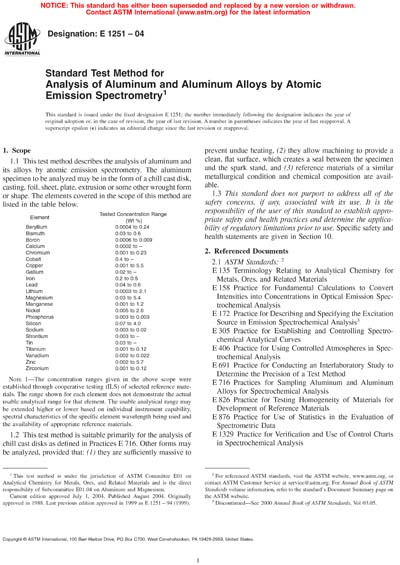
1.1 This test method describes the analysis of aluminum and its alloys by atomic emission spectrometry. The aluminum specimen to be analyzed may be in the form of a chill cast disk, casting, foil, sheet, plate, extrusion or some other wrought form or shape. The elements covered in the scope of this method are listed in the table below.
| Element | Tested Concentration Range(Wt %) |
| Beryllium | 0.0004 to 0.24 |
| Bismuth | 0.03 to 0.6 |
| Boron | 0.0006 to 0.009 |
| Calcium | 0.0002 to - |
| Chromium | 0.001 to 0.23 |
| Cobalt | 0.4 to - |
| Copper | 0.001 to 5.5 |
| Gallium | 0.02 to - |
| Iron | 0.2 to 0.5 |
| Lead | 0.04 to 0.6 |
| Lithium | 0.0003 to 2.1 |
| Magnesium | 0.03 to 5.4 |
| Manganese | 0.001 to 1.2 |
| Nickel | 0.005 to 2.6 |
| Phosphorus | 0.003 to 0.003 |
| Silicon | 0.07 to 4.0 |
| Sodium | 0.003 to 0.02 |
| Strontium | 0.003 to - |
| Tin | 0.03 to - |
| Titanium | 0.001 to 0.12 |
| Vanadium | 0.002 to 0.022 |
| Zinc | 0.002 to 5.7 |
| Zirconium | 0.001 to 0.12 |
1.2 This test method is suitable primarily for the analysis of chill cast disks as defined in Practices E 716. Other forms may be analyzed, provided that: (1) they are sufficiently massive to prevent undue heating, (2) they allow machining to provide a clean, flat surface, which creates a seal between the specimen and the spark stand, and (3) reference materials of a similar metallurgical condition and chemical composition are available.
1.3 This standard does not purport to address all of the safety concerns, if any, associated with its use. It is the responsibility of the user of this standard to establish appropriate safety and health practices and determine the applicability of regulatory limitations prior to use.
ASTM International [astm]