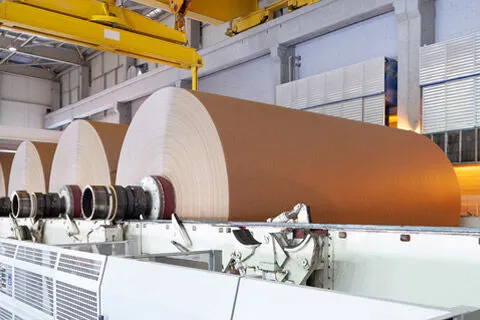
Paper Production and Safety

Paper production and safety standards are published primarily by ISO and ASTM, but many SDOs provide some kind of paper-related standard.The topics compiled here cover many facets of creating paper for many different applications. For instance, many physical aspects of paper, such as air permanence, amount of friction, and even labeling of end items that incorporate plastics and polymers. Other standards cover chemical aspects, such as chlorine concentration and concentration of other chemicals.

ISO 21993:2020

Paper and pulp - Deinkability test for printed paper products

This document specifies a basic laboratory test method for deinkability, applicable to any kind of printed paper product, under alkaline conditions by means of single stage flotation deinking and fatty acid-based collector chemistry.

BS EN ISO 12643-1:2023

Graphic technology — Safety requirements for graphic technology equipment and systems Part 1: General requirements (British Standard)

This document provides safety specifications for the design and construction of new equipment used in prepress systems, printing press systems, binding and finishing systems, converting systems, corrugated board manufacturing systems and stand alone platen presses. It is applicable to equipment used in stand-alone mode, or in combination with other machines, including ancillary equipment, in which all the machine actuators (e.g. drives) of the equipment are controlled by the same control system. The requirements given in this document are applicable to the equipment covered by ISO 12643 (all parts), unless otherwise noted. This document is intended to be used in conjunction with the applicable part of ISO 12643 that contains additional requirements specific to a particular type of equipment. This document addresses recognized significant hazards specific to equipment and systems in the following areas: — mechanical; — electrical; — slipping, tripping, falling; — ergonomics; — noise; — UV and laser radiation; — fire and explosion; — thermal; — substances and material used for processing; — failure, malfunction of control system; — other types of emissions [e.g. ozone, ink mist, volatile organic compounds (VOCs), etc.]. This document is not applicable to: — equipment manufactured before the date of its publication; — ordinary office equipment for digital printing and paper processing, such as digital printers, copiers, sorters, binders and staplers, which is intended for use outside the printing and paper industry; — winder-slitters and sheeters in paper finishing (sheeters with unwinders); — office-type collating machines equipped with friction feeders; — mail processing machines; — machines used for filling packages (such as machines for shaping, filling, and closing the package); and — textile printing presses. The safety principles established in this document can also be applicable to the design of equipment within areas of technology that are not specified in ISO 12643 (all parts).

BS ISO 5636-5:2013

Paper and board. Determination of air permeance (medium range). Gurley method (British Standard)

ISO 5636-5:2013 specifies the Gurley method for determining the air permeance of paper and board using an air resistance tester, the Gurley apparatus.

It is applicable to papers and boards which have air permeances between 0,1 m/(Pa⋅s) and 100 m/(Pa⋅s) when tested with the Gurley apparatus.

It is unsuitable for rough-surfaced materials, which cannot be securely clamped to avoid leakage.

ISO 5636-5:2013 may also be used to determine the air resistance of paper and board.

BS ISO 15359:1999

Paper and board. Determination of the static and kinetic coefficients of friction. Horizontal plane method (British Standard)

This International Standard specifies

  • a friction-testing method based on the horizontal plane principle, and
  • the procedure for the determination of the static coefficient of friction before, and static and kinetic coefficients of friction after, a specified amount of wear between the surfaces.

It is applicable to paper and board.

ASTM D6868-21

Standard Specification for Labeling of End Items that Incorporate Plastics and Polymers as Coatings or Additives with Paper and Other Substrates Designed to be Aerobically Composted in Municipal or Industrial Facilities

1.1 This specification covers end items that include plastics or polymers where plastic film/ sheet or polymers are incorporated (either through lamination, extrusion or mixing) to substrates and the entire end item is designed to be composted under aerobic conditions in municipal and industrial composting facilities, where thermophilic temperatures are achieved.

1.2 This specification is intended to establish the requirements for labeling of end items which use plastics or polymers as coatings or binders, as “compostable in aerobic municipal and industrial composting facilities.”

1.3 The properties in this specification are those required to determine if end items (including packaging) which use plastics and polymers as coatings or binders will compost satisfactorily, in large scale aerobic municipal or industrial composting where maximum throughput is a high priority and where intermediate stages of plastic biodegradation must not be visible to the end user for aesthetic reasons.

1.4 The following safety hazards caveat pertains to the test methods portion of this standard: This standard does not purport to address all of the safety concerns, if any, associated with its use. It is the responsibility of the user of this standard to establish appropriate safety, health, and environmental practices and determine the applicability of regulatory limitations prior to use.

Note 1: There is no known ISO equivalent for this standard.

1.5 This international standard was developed in accordance with internationally recognized principles on standardization established in the Decision on Principles for the Development of International Standards, Guides and Recommendations issued by the World Trade Organization Technical Barriers to Trade (TBT) Committee.

IEC 60814 Ed. 2.0 b:1997

Insulating liquids - Oil-impregnated paper and pressboard - Determination of water by automatic coulometric Karl Fischer titration

Describes methods for the determination of water in insulating liquids and in oil-impregnated cellulosic insulation with coulmetrically generated Karl Fischer reagent.

BS EN 14719:2005

Pulp, paper and board. Determination of the diisopropylnaphthalene (DIPN) content by solvent extraction (British Standard)

This European Standard describes a method for the determination of the content of diisopropylnaphthalene (DIPN) in paper, board and pulp by solvent extraction. The content of diisopropylnaphthalene (DIPN) is expressed as mg of total diisopropylnaphthalene DIPN isomers per kilogram of paper, board or pulp. This test method is appropriate for the quantitative determination of the content of diisopropylnaphthalene (DIPN) with a limit of determination of about 0,6 mg/kg.

ISO 536:2019

Paper and board - Determination of grammage

This document specifies a method for determining the grammage of paper and board.

BS EN 14338:2003

Paper and board intended to come into contact with foodstuffs. Conditions for determination of migration from paper and board using modified polyphenylene oxide (MPPO) as a simulant (British Standard)

This European Standard specifies a method to assess the transfer or migration of specific volatile and semivolatile substances from paper and board. This test method is developed for paper and board intended to come in contact with dry, non fatty foodstuffs and paper and board for baking purposes. In the last case the modified polyphenylenoxide (MPPO) can be seen as a substitute simulant for fatty contact. NOTE MPPO can also be seen as a substitute simulant for olive oil.

ISO 536:2019

Paper and board - Determination of grammage

This document specifies a method for determining the grammage of paper and board.

ISO 535:2023

Paper and board - Determination of water absorptiveness - Cobb method

This document specifies a method for determining the water absorptiveness of paper and board, including corrugated fibreboard, under standard conditions.


This document is not applicable for paper of grammage less than 50 g/m2 or embossed paper. It is not applicable for porous papers such as newsprint or papers such as blotting paper or other papers having a relatively high-water absorptiveness for which ISO 8787 is more suitable.

TAPPI/ANSI T 437 om-21

Dirt in Paper and Paperboard

This method (1-3) is suited for the visual estimation of dirt in paper or paperboard in terms of equivalent black area. For dirt in pulp, see TAPPI T 213 "Dirt in Pulp."

ISO 2493-1:2010

Paper and board - Determination of bending resistance - Part 1: Constant rate of deflection

ISO 2493-1:2010 specifies procedures, based on the two-point loading principle, for determining the bending resistance of paper and board.

ISO 2493-1:2010 applies to the measurement of the bending resistance within the range 20 mN to 10 000 mN. It is not applicable to corrugated board but can be applicable to the components of such board.

The bending angle is 15° and the bending length is 50 mm.

For samples having a bending resistance that is too low to measure with a bending length of 50 mm, a shorter bending length, i.e. 10 mm, can be used.

For boards that tend to be permanently deformed if bent through 15°, the half bending angle, i.e. 7,5°, can be used.

ISO 2493-2:2020

Paper and board - Determination of resistance to bending - Part 2: Taber-type tester

This document specifies procedures to measure the bending resistance of paper and paperboard using a Taber-type tester.

This document is used to determine the bending moment required to deflect the free end of a 38 mm wide vertically clamped specimen by 15° when the load is applied at a bending length of 50 mm. For boards that tend to be permanently deformed if bent through 15°, the half bending angle, i.e. 7,5°, can be used. The bending resistance is expressed in terms of the bending moment and parameters set by the manufacturer of the Taber-type tester.

The method is primarily used for papers with a high grammage.

NOTE This document does not cover the low-range version of the Taber-type instrument that uses a bending length of 10 mm (see Reference [5]).

ASTM D774/D774M-97(2007)

Standard Test Method for Bursting Strength of Paper

1.1 This test method covers measurements of the bursting strength of paper and paper products occurring as single or laminated flat sheets not over 0.6 mm [0.025 in.] in thickness having a bursting strength of 30 kPa up to 1400 kPa [4 psi up to 200 psi].

1.2 This test method is not intended for use in testing corrugated boxboard, liner board, or hardboards that tend to cut the thin rubber diaphragm.

Note 1—Similar procedures for making bursting strength measurements are found in ISO 2758 and TAPPI 403.

1.3 The values stated in either SI units or in other units shall be regarded separately as standard. The values stated in each system may not be exact equivalents; therefore, each system must be used independently of the other, without combining values in any way.

1.4This standard does not purport to address all of the safety concerns, if any, associated with its use. It is the responsibility of the user of this standard to establish appropriate safety and health practices and determine the applicability of regulatory limitations prior to use.