Most recent
ASCE MOP 154-2023
Geotechnical Baseline Reports
Prepared by the Task Committee on Geotechnical Baseline Reports of the Construction Institute of ASCE
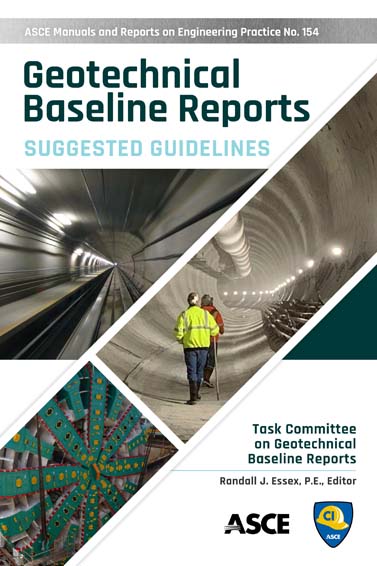
Geotechnical Baseline Reports: Suggested Guidelines, MOP 154, explains the role of the geotechnical baseline report (GBR) in allocating and managing risks associated with subsurface construction. MOP 154 contains recommendations for what should and should not be included in the GBR, provides a chapter outline and a checklist of topics to consider, provides suggested page lengths, makes suggestions that will improve clarity and understanding, and presents examples of problematic and improved practices in creating baselines.
Expanding on earlier titles, MOP 154 provides new perspectives in the following areas:
- Improvement of GBRs through more concise organization and better presentation and wording of baselines;
- For Design-Build (DB) delivery, guidance on collaboration between the owner’s team and the DB team during GBR development;
- Importance of having experienced professionals engaged in the GBR writing, review, and integration with other contract documents;
- Discussion of conditions and obstructions that have led to claims on past projects;
- Broadened discussion of applications of GBRs to geotechnical construction other than tunnels and shafts;
- Discussion of legal and contractual perspectives that address trends in contractor claims and lawsuits by owners or contractors;
- Practices and lessons learned based on experience over the last 15 years; and
- Case histories that illustrate how baselines were utilized to resolve disputes.
MOP 154 is intended to serve as a reference for preparers and users of GBRs, and to inform owners of the importance of using GBRs to allocate financial risk fairly between the parties.
ASCE: American Society of Civil Engineers [asce]