Most recent
ASTM D2434-26
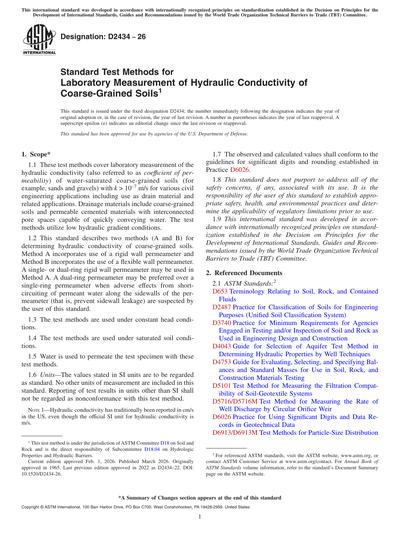
Standard Test Methods for Laboratory Measurement of Hydraulic Conductivity of Coarse-Grained Soils
1.1 These test methods cover laboratory measurement of the hydraulic conductivity (also referred to as coefficient of permeability) of water-saturated coarse-grained soils (for example, sands and gravels) with k > 10–7 m/s for various civil engineering applications including use as drain material and related applications. Drainage materials include coarse-grained soils and permeable cemented materials with interconnected pore spaces capable of quickly conveying water. The test methods utilize low hydraulic gradient conditions.
1.2 This standard describes two methods (A and B) for determining hydraulic conductivity of coarse-grained soils. Method A incorporates use of a rigid wall permeameter and Method B incorporates the use of a flexible wall permeameter. A single- or dual-ring rigid wall permeameter may be used in Method A. A dual-ring permeameter may be preferred over a single-ring permeameter when adverse effects from short-circuiting of permeant water along the sidewalls of the permeameter (that is, prevent sidewall leakage) are suspected by the user of this standard.
1.3 The test methods are used under constant head conditions.
1.4 The test methods are used under saturated soil conditions.
1.5 Water is used to permeate the test specimen with these test methods.
1.6 Units—The values stated in SI units are to be regarded as standard. No other units of measurement are included in this standard. Reporting of test results in units other than SI shall not be regarded as nonconformance with this test method.
Note 1: Hydraulic conductivity has traditionally been reported in cm/s in the US, even though the official SI unit for hydraulic conductivity is m/s.
1.7 The observed and calculated values shall conform to the guidelines for significant digits and rounding established in Practice D6026.
1.8 This standard does not purport to address all of the safety concerns, if any, associated with its use. It is the responsibility of the user of this standard to establish appropriate safety, health, and environmental practices and determine the applicability of regulatory limitations prior to use.
1.9 This international standard was developed in accordance with internationally recognized principles on standardization established in the Decision on Principles for the Development of International Standards, Guides and Recommendations issued by the World Trade Organization Technical Barriers to Trade (TBT) Committee.
ASTM International [astm]