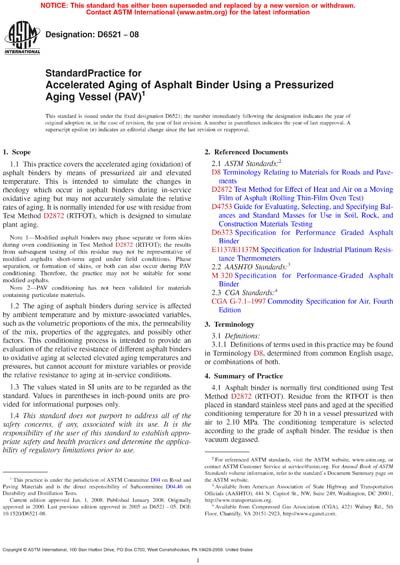
Standard Practice for Accelerated Aging of Asphalt Binder Using a Pressurized Aging Vessel (PAV)
1.1 This practice covers the accelerated aging (oxidation) of asphalt binders by means of pressurized air and elevated temperature. This is intended to simulate the changes in rheology which occur in asphalt binders during in-service oxidative aging but may not accurately simulate the relative rates of aging. It is normally intended for use with residue from Test Method D 2872 (RTFOT), which is designed to simulate plant aging.
Note 1—Modified asphalt binders may phase separate or form skins during oven conditioning in Test Method D 2872 (RTFOT); the results from subsequent testing of this residue may not be representative of modified asphalts short-term aged under field conditions. Phase separation, or formation of skins, or both can also occur during PAV conditioning. Therefore, the practice may not be suitable for some modified asphalts.
Note 2—PAV conditioning has not been validated for materials containing particulate materials.
1.2 The aging of asphalt binders during service is affected by ambient temperature and by mixture-associated variables, such as the volumetric proportions of the mix, the permeability of the mix, properties of the aggregates, and possibly other factors. This conditioning process is intended to provide an evaluation of the relative resistance of different asphalt binders to oxidative aging at selected elevated aging temperatures and pressures, but cannot account for mixture variables or provide the relative resistance to aging at in-service conditions.
1.3 The values stated in SI units are to be regarded as the standard. Values in parentheses in inch-pound units are provided for informational purposes only.
1.4 This standard does not purport to address all of the safety concerns, if any, associated with its use. It is the responsibility of the user of this standard to establish appropriate safety and health practices and determine the applicability of regulatory limitations prior to use.
Please first log in with a verified email before subscribing to alerts.
Your Alert Profile lists the documents that will be monitored. If the document is revised or amended, you will be notified by email. You may delete a document from your Alert Profile at any time. To add a document to your Profile Alert, search for the document and click “Add to Alert”.
ADD ALERT
Already Subscribed to this document.
Your Alert Profile lists the documents that will be monitored. If the document is revised or amended, you will be notified by email. You may delete a document from your Alert Profile at any time. To add a document to your Profile Alert, search for the document and click “Add to Alert”.
PDF DOCUMENT FORMAT
Documents sold on the ANSI Webstore are in electronic Adobe Acrobat PDF format , however some ISO and IEC standards are available from Amazon in hard copy format.
DRM PROTECTED DOCUMENTS
Some PDF files are protected by Digital Rights Management (DRM) at the request of the copyright holder. You can download and open this file to your own computer but DRM prevents opening this file on another computer, including a networked server.
Some copyright holders may impose other restrictions that limit document printing and copy/paste of documents.
NON PRINTABLE DOCUMENTS
Those documents cannot be printed at the request of the copyright holder.
We have no amendments or corrections for this standard.
Are the documents at the ANSI Webstore in electronic Adobe Acrobat PDF format only?
Documents sold on the ANSI Standards Store are in electronic Adobe Acrobat PDF format.however some ISO and IEC standards are available from Amazon in hard copy format.