Most recent
ASTM E1019-24
Standard Test Methods for Determination of Carbon, Sulfur, Nitrogen, and Oxygen in Steel, Iron, Nickel, and Cobalt Alloys by Combustion and Inert Gas Fusion Techniques
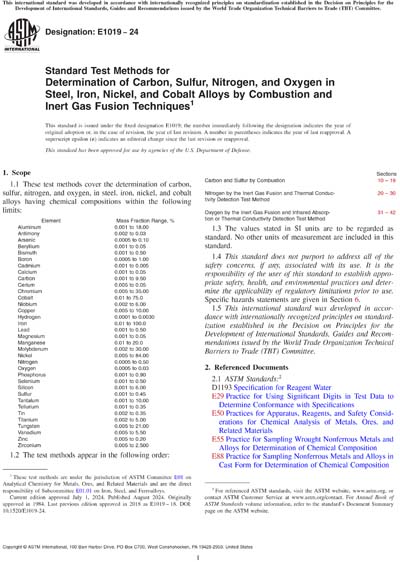
1.1 These test methods cover the determination of carbon, sulfur, nitrogen, and oxygen, in steel, iron, nickel, and cobalt alloys having chemical compositions within the following limits:
| Element | Mass Fraction Range, % |
| Aluminum | 0.001 to 18.00 |
| Antimony | 0.002 to 0.03 |
| Arsenic | 0.0005 to 0.10 |
| Beryllium | 0.001 to 0.05 |
| Bismuth | 0.001 to 0.50 |
| Boron | 0.0005 to 1.00 |
| Cadmium | 0.001 to 0.005 |
| Calcium | 0.001 to 0.05 |
| Carbon | 0.001 to 9.50 |
| Cerium | 0.005 to 0.05 |
| Chromium | 0.005 to 35.00 |
| Cobalt | 0.01 to 75.0 |
| Niobium | 0.002 to 6.00 |
| Copper | 0.005 to 10.00 |
| Hydrogen | 0.0001 to 0.0030 |
| Iron | 0.01 to 100.0 |
| Lead | 0.001 to 0.50 |
| Magnesium | 0.001 to 0.05 |
| Manganese | 0.01 to 20.0 |
| Molybdenum | 0.002 to 30.00 |
| Nickel | 0.005 to 84.00 |
| Nitrogen | 0.0005 to 0.50 |
| Oxygen | 0.0005 to 0.03 |
| Phosphorus | 0.001 to 0.90 |
| Selenium | 0.001 to 0.50 |
| Silicon | 0.001 to 6.00 |
| Sulfur | 0.001 to 0.45 |
| Tantalum | 0.001 to 10.00 |
| Tellurium | 0.001 to 0.35 |
| Tin | 0.002 to 0.35 |
| Titanium | 0.002 to 5.00 |
| Tungsten | 0.005 to 21.00 |
| Vanadium | 0.005 to 5.50 |
| Zinc | 0.005 to 0.20 |
| Zirconium | 0.005 to 2.500 |
1.2 The test methods appear in the following order:
|
| Sections |
| Carbon and Sulfur by Combustion | 10 – 19 |
|
|
|
| Nitrogen by the Inert Gas Fusion and Thermal Conductivity Detection Test Method | 20 – 30 |
|
|
|
| Oxygen by the Inert Gas Fusion and Infrared Absorption or Thermal Conductivity Detection Test Method | 31 – 42 |
1.3 The values stated in SI units are to be regarded as standard. No other units of measurement are included in this standard.
1.4 This standard does not purport to address all of the safety concerns, if any, associated with its use. It is the responsibility of the user of this standard to establish appropriate safety, health, and environmental practices and determine the applicability of regulatory limitations prior to use. Specific hazards statements are given in Section 6.
1.5 This international standard was developed in accordance with internationally recognized principles on standardization established in the Decision on Principles for the Development of International Standards, Guides and Recommendations issued by the World Trade Organization Technical Barriers to Trade (TBT) Committee.
ASTM International [astm]