Standard Practice for Qualification of a Combination of Squeeze Tool, Pipe, and Squeeze-Off Procedures to Avoid Long-Term Damage in Polyethylene (PE) Gas Pipe
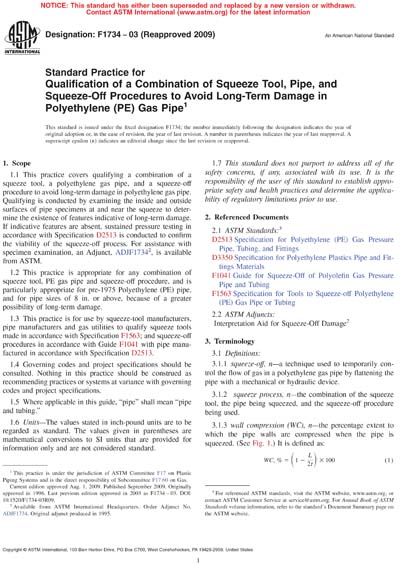
1.1 This practice covers qualifying a combination of a squeeze tool, a polyethylene gas pipe, and a squeeze-off procedure to avoid long-term damage in polyethylene gas pipe. Qualifying is conducted by examining the inside and outside surfaces of pipe specimens at and near the squeeze to determine the existence of features indicative of long-term damage. If indicative features are absent, sustained pressure testing in accordance with Specification D 2513 is conducted to confirm the viability of the squeeze-off process. For assistance with specimen examination, an Adjunct, ADJF1734 , is available from ASTM.
1.2 This practice is appropriate for any combination of squeeze tool, PE gas pipe and squeeze-off procedure, and is particularly appropriate for pre-1975 Polyethylene (PE) pipe, and for pipe sizes of 8 in. or above, because of a greater possibility of long-term damage.
1.3 This practice is for use by squeeze-tool manufacturers, pipe manufacturers and gas utilities to qualify squeeze tools made in accordance with Specification F 1563; and squeeze-off procedures in accordance with Guide F 1041 with pipe manufactured in accordance with Specification D 2513.
1.4 Governing codes and project specifications should be consulted. Nothing in this practice should be construed as recommending practices or systems at variance with governing codes and project specifications.
1.5 Where applicable in this guide, “pipe” shall mean “pipe and tubing.”
1.6 Units—The values stated in inch-pound units are to be regarded as standard. The values given in parentheses are mathematical conversions to SI units that are provided for information only and are not considered standard.
1.7 This standard does not purport to address all of the safety concerns, if any, associated with its use. It is the responsibility of the user of this standard to establish appropriate safety and health practices and determine the applicability of regulatory limitations prior to use.
Please first log in with a verified email before subscribing to alerts.
Your Alert Profile lists the documents that will be monitored. If the document is revised or amended, you will be notified by email. You may delete a document from your Alert Profile at any time. To add a document to your Profile Alert, search for the document and click “Add to Alert”.
ADD ALERT
Already Subscribed to this document.
Your Alert Profile lists the documents that will be monitored. If the document is revised or amended, you will be notified by email. You may delete a document from your Alert Profile at any time. To add a document to your Profile Alert, search for the document and click “Add to Alert”.
PDF DOCUMENT FORMAT
Documents sold on the ANSI Webstore are in electronic Adobe Acrobat PDF format , however some ISO and IEC standards are available from Amazon in hard copy format.
DRM PROTECTED DOCUMENTS
Some PDF files are protected by Digital Rights Management (DRM) at the request of the copyright holder. You can download and open this file to your own computer but DRM prevents opening this file on another computer, including a networked server.
Some copyright holders may impose other restrictions that limit document printing and copy/paste of documents.
NON PRINTABLE DOCUMENTS
Those documents cannot be printed at the request of the copyright holder.
We have no amendments or corrections for this standard.
Are the documents at the ANSI Webstore in electronic Adobe Acrobat PDF format only?
Documents sold on the ANSI Standards Store are in electronic Adobe Acrobat PDF format.however some ISO and IEC standards are available from Amazon in hard copy format.