Most recent
ASTM F2352-14(2022)
Standard Specification for Design and Performance of Light Sport Gyroplane Aircraft
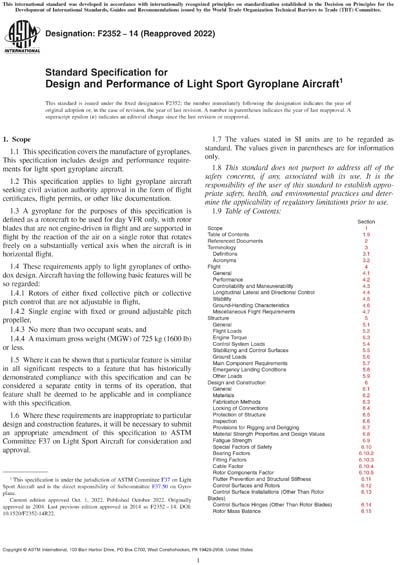
1.1This specification covers the manufacture of gyroplanes. This specification includes design and performance requirements for light sport gyroplane aircraft.
1.2This specification applies to light gyroplane aircraft seeking civil aviation authority approval in the form of flight certificates, flight permits, or other like documentation.
1.3A gyroplane for the purposes of this specification is defined as a rotorcraft to be used for day VFR only, with rotor blades that are not engine-driven in flight and are supported in flight by the reaction of the air on a single rotor that rotates freely on a substantially vertical axis when the aircraft is in horizontal flight.
1.4These requirements apply to light gyroplanes of orthodox design. Aircraft having the following basic features will be so regarded:
1.4.1Rotors of either fixed collective pitch or collective pitch control that are not adjustable in flight,
1.4.2Single engine with fixed or ground adjustable pitch propeller,
1.4.3No more than two occupant seats, and
1.4.4A maximum gross weight (MGW) of 725 kg (1600 lb) or less.
1.5Where it can be shown that a particular feature is similar in all significant respects to a feature that has historically demonstrated compliance with this specification and can be considered a separate entity in terms of its operation, that feature shall be deemed to be applicable and in compliance with this specification.
1.6Where these requirements are inappropriate to particular design and construction features, it will be necessary to submit an appropriate amendment of this specification to ASTM Committee F37 on Light Sport Aircraft for consideration and approval.
1.7The values stated in SI units are to be regarded as standard. The values given in parentheses are for information only.
1.8This standard does not purport to address all of the safety concerns, if any, associated with its use. It is the responsibility of the user of this standard to establish appropriate safety, health, and environmental practices and determine the applicability of regulatory limitations prior to use.
1.9Table of Contents:
1.10This international standard was developed in accordance with internationally recognized principles on standardization established in the Decision on Principles for the Development of International Standards, Guides and Recommendations issued by the World Trade Organization Technical Barriers to Trade (TBT) Committee.
ASTM International [astm]