Historical
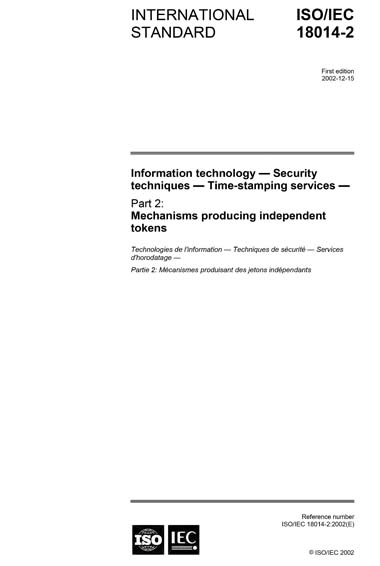
ISO/IEC 18014-2:2002
Information technology - Security techniques - Time-stamping services - Part 2: Mechanisms producing independent tokens
ISO/IEC 18014-2:2002 describes time-stamping services producing independent tokens. It describes a general model for time-stamping services of this type and the basic components used to construct a time-stamping service of this type, it defines the data structures and protocols used to interact with a time-stamping service of this type, and it describes specific instances of such time-stamping services.
The usage of independent tokens presumes a high trust on the time-stamping authority (TSA).
Three independent mechanisms are currently covered:
Time-stamps using digital signatures
In this mechanism the TSA has an asymmetric key pair, and uses the private key to digitally sign the time-stamp token. Signature verification will use the public key. This mechanism may require the use of a PKI (Public Key Infrastructure).
Time-stamps using message authentication codes
In this mechanism the TSA uses a secret key to digitally bind the time association. The time-stamp token is authenticated using a Message Authentication Code (MAC). When using this mechanism, the TSA is needed to carry out the verification.
Time-stamps using archiving
In this mechanism the TSA returns a time-stamp token that only has reference information to bind the time-stamp to the messageImprint in the time-stamp token. The TSA archives locally enough information to verify that the time-stamp is correct.
International Organization for Standardization [iso]