PDF Price
$0.00
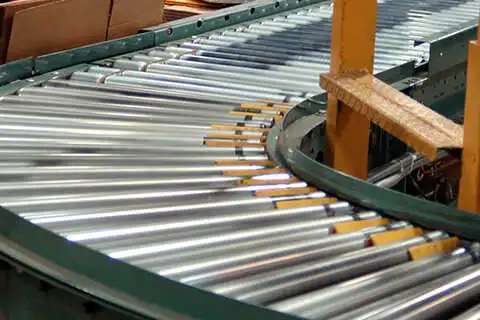
General safety standards cover a wide variety of safety standards for different applications, all of which complement OSHA 1910 requirements and conform to best practices. A popular standard listed here is ASME B20.1, the Safety Standard for Conveyors and Related Equipment.
The purpose of this standard is to provide reasonable safety for life, limb, and property. In order to develop an effective safety program, the standard may serve also as a basis for purchase requirements and for instructions in personnel training, and in the preparation of motivational/ instructional material such as safety practices, manuals, posters, and the like. This standard is also intended to provide the manufacturer, purchaser, and user of metal ladders with a set of performance and dimensional requirements against which a product may be compared. It is not the purpose of this standard to specify all the details of construction of portable metal ladders. The limitations imposed are for the purpose of providing adequate general requirements and testing methods needed for consistency.
This standard prescribes minimum requirements for the design, construction, and use of fixed ladders, and sets forth requirements for cages, wells, and ladder safety systems used with fixed ladders, in order to minimize personal injuries. All parts and appurtenances necessary for a safe and efficient ladder shall be considered integral parts of the design.
This part of ANSI/ASA S1.4 / IEC 61672 gives electroacoustical performance specifications for three kinds of sound-measuring instruments: a time-weighting sound level meter that measures exponentialtime- weighted, frequency-weighted sound levels; an integrating-averaging sound level meter that measures time-averaged, frequency-weighted sound levels; and an integrating sound level meter that measures frequency-weighted sound exposure levels
ANSI/ASA S1.4-2014/Part 2 / IEC 61672-2:2013 provides details of the tests necessary to verify conformance to all mandatory specifications given in ANSI/ASA S1.4-2014/Part 1 / IEC 61672-1:2013 for time-weighting sound level meters, integrating-averaging sound level meters, and integrating sound level meters.
ANSI/ASA S1.4-2014/Part 3 / IEC 61672-3:2013 describes procedures for periodic testing of time-weighting, integrating-averaging, and integrating sound level meters that were designed to conform to the class 1 or class 2 specifications of ANSI/ASA S1.4-2014/Part 1 / IEC 61672-1. The aim of the standard is to ensure that periodic testing is performed in a consistent manner by all laboratories
Specifies performance requirements for analogue, sampled-data, and digital implementations of band-pass filters. The extent of the pass-band region of a filter's relative attenuation characteristic is a constant percentage of the exact mid-band frequency for all filters of a given bandwidth. An instrument conforming to the requirements of this standard may contain any number of contiguous band-pass filters covering any desired frequency range.
This standard specifies laboratory-based procedures for measuring, analyzing, and reporting the passive noise-reducing capabilities of hearing protectors. The procedures consist of psychophysical tests conducted on human subjects to determine the real-ear attenuation measured at hearing threshold. Two fitting procedures are provided: Method A) trained-subject fit, intended to describe the capabilities of the devices fitted by carefully trained users, and Method B) inexperienced-subject fit, utilizes subjects with little or no experience with respect to the use of hearing protection, in order to approximate the attenuation that can be attained by groups of users as reported in real-world occupational studies. Regardless of test method, the attenuation data will be valid only to the extent that the users wear the devices in the same manner as during the tests. This standard does not address issues pertaining to computational schemes or rating systems for applying hearing protector attenuation values (see ANSI/ ASA S12.68), nor does it specify minimum performance values for hearing protectors, or addresscomfort or wearability features. Method A of this standard corresponds to ISO 4869-1:1990, Acoustics –Hearing protectors – Part 1: Subjective method for the measurement of sound attenuation, and Method B corresponds to ISO/TS 4869-5:2006, Acoustics – Hearing protectors – Part 5: Method for estimation of noise reduction using fitting by inexperienced test subjects.
The audiometers covered in this specification are devices designed for use in determining the hearing threshold level of an individual in comparison with a chosen standard reference threshold level. This standard provides specifications and tolerances for pure tone, speech, and masking signals and describes the minimum test capabilities of different types of audiometers. Methods and requirements for calibration of audiometers are provided.
Establishes specifications that define a unique identification emblem, the Slow Moving Vehicle Emblem (SMV Emblem), to be used only for slow moving machines (vehicles), when operated or traveling on public roads.
This Standard establishes safety requirements for powered platforms (scaffolds) for buildings where window cleaning and related services are accomplished by means of suspended equipment at heights in excess of 35 ft (11 m) above a safe surface (e.g., grade, street, floor, or roof level).
A13.1 establishes a common system to assist in identification of fluids conveyed in piping and their characteristics. The Standard describes requirements for the identification of aboveground piping used in industrial, commercial, transmission, distribution, and institutional installations, and in buildings used for public assembly. It does not apply to electrical conduits.
This Standard applies to the manufacture, installation, maintenance, inspection, and operation of belt manlifts. Belt manlifts covered by this Standard consist of steps (platforms) and accompanying handholds mounted on or attached to an endless belt that operates vertically in one direction only and is supported by and driven through pulleys at the top and bottom.
B20.1 applies to the design, construction, installation, maintenance, inspection, and operation of conveyors and conveying systems in relation to hazards. The conveyors may be of the bulk material, package, or unit handling types where the installation is designed for permanent, temporary, or portable operation. This Standard shall apply, with the exceptions noted below, to all conveyor installations. This Standard specifically excludes any conveyor designed for, installed for, or used primarily for the movement of human beings. This Standard does, however, apply to certain conveying devices that incorporate within their supporting structure work stations or operator's stations specifically designed for authorized operating personnel.
The ASME A17.1 / CSA B44 Safety Code for Elevators and Escalators has become the accepted guide throughout North America for the design, construction, installation, operation, inspection, testing, maintenance, alteration, and repair of elevators, escalators and related conveyances.
One of ASME's most popular safety standards addresses elevators, escalators, dumbwaiters, moving walks and material lifts. It provides requirements applying to the design, construction, installation, operation, testing, inspection, maintenance, alteration and repair of these conveyances.
Volume B30.2 includes provisions that apply to the construction, installation, operation, inspection, and maintenance of hand-operated and power-driven overhead and gantry cranes that have a top-running single girder or multiple girder bridge, with one or more top-running trolley hoists used for vertical lifting and lowering of freely suspended, unguided loads consisting of equipment and materials.
ASME B30.5 is one of ASME's most requested safety standards--widely respected and applied throughout the building and construction industry. It addresses crawler cranes, locomotive cranes, wheel-mounted cranes, and any variations thereof that retain the same fundamental characteristics and are powered by internal combustion engines or electric motors. The scope of this Safety Standard includes only cranes of the above types that are powered by internal combustion engines or electric motors. Side boom tractors and cranes designed for railway and automobile wreck clearance, digger derricks, cranes manufactured specifically for, or when used for, energized electrical line service, knuckle boom, trolley boom cranes, and cranes having a maximum rated capacity of one ton or less are excluded. B30.5 offers comprehensive solutions applying to the construction, inspection, testing, maintenance and operation of mobile and locomotive cranes. It is to be used in conjunction with equipment described in other volumes of the ASME B30 series of safety standards. Careful application of these B30 safety standards will help users to comply with applicable regulations within their jurisdictions, while achieving the operational and safety benefits to be gained from the many industry best-practices detailed in these volumes.
B30.6 applies to the construction, installation, operation, inspection, testing, and maintenance of guy, stiffleg, basket, breast, gin pole, Chicago boom, shearleg, and A-frame derricks. These derricks, powered by winches through systems of wire rope reeving, are used for lifting, lowering, and horizontal movement of freely suspended unguided loads. Derricks are usually stationary mounted and may be temporarily or permanently installed. The provisions included in this volume also apply to any variations of these types of derricks with the same fundamental characteristics, except those specified for floating derricks in ASME B30.8, Floating Cranes and Floating Derricks.
ASME B31.1 prescribes minimum requirements for the design, materials, fabrication, erection, test, examination, inspection, operation, and maintenance of piping systems typically found in electric power generating stations, industrial and institutional plants, geothermal heating systems, and central and district heating and cooling systems. It also covers boiler-external piping for power boilers and high-temperature, high pressure water boilers in which steam or vapor is generated at a pressure of more than 15 psig [100 kPa (gage)]; and high temperature water is generated at pressures exceeding 160 psig [1,103 kPa (gage)] and/or temperatures exceeding 250 degrees F (120 degrees C). ASME B31.1 is one of ASME's most requested codes, widely adopted by jurisdictions worldwide. It is prominently referenced in ASME's Boiler and Pressure Vessel Code, Section I. This Code serves as a companion to ASME's B31.3 Code on Process Piping as well as to the other codes in ASME's B31 series. Together, they remain essential references for anyone engaged with piping. Intended for manufacturers, designers, operators and owners of piping systems including, but not limited to, steam, water, oil, gas, and air services, plus all potential governing entities.
This Code covers the design, fabrication, installation, and testing of piping systems for fuel gases such as natural gas, manufat cured gas, liquefied petroleum gas (LPG)-air mixtures above the upper combustible limit, liquefied petroleum gas (LPG) in the gaseous phase, or mixtures of these gases. Included within the scope of this Code are fuel gas piping systems both in buildings and between buildings, from the outlet of the consumer's meter set assembly (or point of delivery) to and including the first pressure containing valve upstream of the gas utilization device. Piping systems within the scope of this Code include all components such as pipe, valves, fittings, flanges (except inlet and outlet flanges that are a part of equipment or apparatus described in Par. 200.1.4), bolting and gaskets. Also included are the pressure containing parts of ocher components such as expansion joints, strainers and metering devices and piping supporting fixtures and structural attachments.
ASME B31.3 contains requirements for piping typically found in petroleum refineries; chemical, pharmaceutical, textile, paper, semiconductor, and cryogenic plants; and related processing plants and terminals. It covers materials and components, design, fabrication, assembly, erection, examination, inspection, and testing of piping.
ASME B31.5 covers Piping and Heat Transfer Components: piping for refrigerants and secondary coolants.
This standard establishes minimum control requirements and ventilation system design criteria for controlling and removing air contaminants to protect the health of personnel engaged in open-surface tank operations.
Establishes minimum requirements for the commissioning, design, specification, construction and installation of fixed industrial local exhaust ventilation (LEV) systems used for the reduction and prevention of employee exposure to harmful airborne substances in the industrial environment.
1.1 This specification covers three classes of gray iron for castings intended for use as valve pressure-retaining parts, pipe fittings, and flanges. 1.2 The values stated in inch-pound units are to be regarded as standard. The values given in parentheses are mathematical conversions to SI units that are provided for information only and are not considered standard. Note 1: The text of this standard references notes and footnotes which provide explanatory material. These notes and footnotes (excluding those in tables and figures) shall not be considered as requirements of the standard. 1.3 This international standard was developed in accordance with internationally recognized principles on standardization established in the Decision on Principles for the Development of International Standards, Guides and Recommendations issued by the World Trade Organization Technical Barriers to Trade (TBT) Committee.
1.1 This specification covers Grade 80 heat-treated alloy steel chain for such applications as slings, lifting assemblies, and load binding. For overhead lifting applications, only alloy chain should be used. 1.2 The chain grade is based on the nominal stress in the link at the design breaking force strength. It is calculated by taking the minimum breaking force load and dividing by two times the nominal cross-sectional area of the link. 1.3 The values stated in either SI units or in other units are to be regarded separately as standard. The values stated in each system are not necessarily exact equivalents; therefore, to ensure conformance with the standard, each system shall be used independently of the other, and values from the two systems shall not be combined. 1.3.1 Metric Units— Grade = 1 / 10 of the minimum breaking force in kilonewtons divided by two times the nominal cross-sectional area in square millimeters. = (MBF)/(0.005)(π)(d)(d) 1.3.2 English Units— Grade = 0.000689 of the minimum breaking force in pounds divided by two times the nominal cross-sectional area in square inches. = (0.000689)(MBF)/(0.5)(π)(d)(d) 1.3.3 MBF = minimum breaking force (lb or kN); d = chain diameter (in. or mm). Note 1: The above formulas are for round diameter links only. If different cross sections are used, the actual cross section of the link would need to be calculated and used. 1.4 This international standard was developed in accordance with internationally recognized principles on standardization established in the Decision on Principles for the Development of International Standards, Guides and Recommendations issued by the World Trade Organization Technical Barriers to Trade (TBT) Committee.
1.1 This specification covers ductile iron castings for pressure-retaining parts for use at elevated temperatures. Castings of all grades are suitable for use up to 450 °F. For temperatures above 450 °F and up to 650 °F, only Grade 60-40-18 castings are suitable ( Note 1 ). 1.2 Valves, flanges, pipe fittings, pumps, and other piping components are generally manufactured in advance and supplied from stock by the manufacturer, jobber, or dealer. 1.3 For supplemental casting requirements, Specification A834 may be utilized. 1.4 The values stated in either SI units or inch-pound units are to be regarded separately as standard. The values stated in each system may not be exact equivalents; therefore, each system shall be used independently of the other. Combining values from the two systems may result in nonconformance with the standard. Note 1: For service other than as specified in this section, reference should be made to Specification A536 for Ductile Iron Castings. 2 1.5 This international standard was developed in accordance with internationally recognized principles on standardization established in the Decision on Principles for the Development of International Standards, Guides and Recommendations issued by the World Trade Organization Technical Barriers to Trade (TBT) Committee.
1.1 This specification 2 covers ferritic malleable castings for general engineering usage at temperatures from normal ambient to approximately 400 °C [750 °F]. 1.2 No precise quantitative relationship can be stated between the properties of the iron in various locations of the same casting and those of a test specimen cast from the same iron (see Appendix X1 ). 1.3 The values stated in either SI units or inch-pound units are to be regarded separately as standard. The values stated in each system may not be exact equivalents; therefore, each system shall be used independently of the other. Combining values from the two systems may result in nonconformance with the standard. 1.4 This international standard was developed in accordance with internationally recognized principles on standardization established in the Decision on Principles for the Development of International Standards, Guides and Recommendations issued by the World Trade Organization Technical Barriers to Trade (TBT) Committee.
1.1 This specification 2 covers seamless and welded black and hot-dipped galvanized steel pipe in NPS 1 / 8 to NPS 26 [DN 6 to DN 650] ( Note 1 ), inclusive, with nominal wall thickness ( Note 2 ) as given in Table X2.2 and Table X2.3 . It shall be permissible to furnish pipe having other dimensions provided that such pipe complies with all other requirements of this specification. Supplementary requirements of an optional nature are provided and shall apply only when specified by the purchaser. Note 1: The dimensionless designators NPS (nominal pipe size) [DN (diameter nominal)] have been substituted in this specification for such traditional terms as “nominal diameter,” “size,” and “nominal size.” Note 2: The term nominal wall thickness has been assigned for the purpose of convenient designation, existing in name only, and is used to distinguish it from the actual wall thickness, which may vary over or under the nominal wall thickness. 1.2 This specification covers the following types and grades: 1.2.1 Type F— Furnace-butt-welded, continuous welded Grades A and B, 1.2.2 Type E— Electric-resistance-welded, Grades A and B, and 1.2.3 Type S— Seamless, Grades A and B. Note 3: See Appendix X1 for definitions of types of pipe. 1.3 Pipe ordered under this specification is intended for mechanical and pressure applications and is also acceptable for ordinary uses in steam, water, gas, and air lines. It is suitable for welding, and suitable for forming operations involving coiling, bending, and flanging, subject to the following qualifications: 1.3.1 Type F is not intended for flanging. 1.3.2 When pipe is required for close coiling or cold bending, Grade A is the preferred grade; however, this is not intended to prohibit the cold bending of Grade B pipe. 1.3.3 Type E is furnished either nonexpanded or cold expanded at the option of the manufacturer. 1.4 The values stated in either SI units or inch-pound units are to be regarded separately as standard. The values stated in each system may not be exact equivalents; therefore, each system shall be used independently of the other. Combining values from the two systems may result in non-conformance with the standard. 1.5 The following precautionary caveat pertains only to the test method portion, Sections 7 , 8 , 9 , 13 , 14 , and 15 of this specification: This standard does not purport to address all of the safety concerns, if any, associated with its use. It is the responsibility of the user of this standard to establish appropriate safety, health, and environmental practices and determine the applicability of regulatory requirements prior to use. 1.6 The text of this specification contains notes or footnotes, or both, that provide explanatory material. Such notes and footnotes, excluding those in tables and figures, do not contain any mandatory requirements. 1.7 This international standard was developed in accordance with internationally recognized principles on standardization established in the Decision on Principles for the Development of International Standards, Guides and Recommendations issued by the World Trade Organization Technical Barriers to Trade (TBT) Committee.
1.1 This practice covers the apparatus, procedure, and conditions required to create and maintain the salt spray (fog) test environment. Suitable apparatus which may be used is described in Appendix X1 . 1.2 This practice does not prescribe the type of test specimen or exposure periods to be used for a specific product, nor the interpretation to be given to the results. 1.3 The values stated in SI units are to be regarded as standard. The values given in parentheses after SI units are provided for information only and are not considered standard. 1.4 This standard does not purport to address all of the safety concerns, if any, associated with its use. It is the responsibility of the user of this standard to establish appropriate safety, health, and environmental practices and determine the applicability of regulatory limitations prior to use. 1.5 This international standard was developed in accordance with internationally recognized principles on standardization established in the Decision on Principles for the Development of International Standards, Guides and Recommendations issued by the World Trade Organization Technical Barriers to Trade (TBT) Committee.
1.1 This specification covers drawn seamless tubes in straight lengths and coils for general purpose and pressure applications in alloys ( Note 2 ), tempers, and thicknesses shown in Table 2 [ Table 3 ]. Coiled tubes are generally available only as round tubes with a wall thickness not exceeding 0.083 in. [2.00 mm] and only in non-heat-treatable alloys. 1.2 Alloy and temper designations are in accordance with ANSI H35.1/H35.1M. The equivalent Unified Numbering System alloy designations are those of Table 1 preceded by A9, for example, A91100 for aluminum designation 1100 in accordance with Practice E527 . Note 1: See Specification B483/B483M for aluminum-alloy drawn tubes for general purpose applications; Specification B234 for aluminum-alloy drawn seamless tubes for condensers and heat exchangers; and Specification B241/B241M for aluminum-alloy seamless pipe and seamless extruded tube. Note 2: Throughout this specification, use of the term alloy in the general sense includes aluminum as well as aluminum alloy. 1.3 For acceptance criteria for inclusion of new aluminum and aluminum alloys in this specification, see Annex A2 . 1.4 The values stated in either SI units or inch-pound units are to be regarded separately as standard. The values stated in each system may not be exact equivalents; therefore, each system shall be used independently of the other. Combining values from the two systems may result in non-conformance with the standard. 1.5 This standard does not purport to address all of the safety concerns, if any, associated with its use. It is the responsibility of the user of this standard to establish appropriate safety, health, and environmental practices and determine the applicability of regulatory limitations prior to use. 1.6 This international standard was developed in accordance with internationally recognized principles on standardization established in the Decision on Principles for the Development of International Standards, Guides and Recommendations issued by the World Trade Organization Technical Barriers to Trade (TBT) Committee.
1.1 This specification 2 covers aluminum and aluminum"“alloy seamless pipe and seamless extruded round tube in the alloys and tempers shown in Table 1 [Table 2] intended for pressure applications. The standard sizes for seamless pipe are listed in Table 16.7 of ANSI H35.2 and H35.2(M). Nonstandard alloys, tempers, and sizes of pipe are produced as seamless extruded tube. Also included in this standard are seamless extruded pipe and seamless extruded tube for Oil Gas Transmission previously covered under Specification B345/B345M . Note 1: Throughout this specification, use of the term alloy, in the general sense, includes aluminum as well as aluminum alloy. Note 2: For drawn seamless tubes, see Specification B210/B210M ; for extruded tubes, Specifications B221 and B221M ; for drawn seamless tubes for condensers and heat exchangers, Specifications B234 and B234M ; for seamless condenser and heat exchanger tubes with integral fins, Specification B429/B429M ; and for drawn tube for general purpose applications, Specification B483/B483M . 1.2 Alloy and temper designations are in accordance with ANSI H35.1/H35.1(M). The equivalent Unified Numbering System alloy designations are those of Table 4 preceded by A9, for example, A91100 for aluminum 1100 in accordance with Practice E527 . 1.3 For acceptance criteria for inclusion of new aluminum and aluminum alloys in this specification, see Annex A2 . 1.4 The values stated in either SI units or inch-pound units are to be regarded separately as standard. The values stated in each system may not be exact equivalents; therefore, each system shall be used independently of the other. Combining values from the two systems may result in non-conformance with the standard. 1.4.1 The SI units are shown either in brackets or in separate tables. 1.5 This international standard was developed in accordance with internationally recognized principles on standardization established in the Decision on Principles for the Development of International Standards, Guides and Recommendations issued by the World Trade Organization Technical Barriers to Trade (TBT) Committee.
1.1 This specification establishes the requirements for seamless copper water tube suitable for general plumbing, similar applications for the conveyance of fluids, and commonly used with solder, flared, or compression-type fittings. The type of copper water tube suitable for any particular application is determined by the internal or external fluid pressure, by the installation and service conditions, and by local requirements. Means of joining or bending are also factors which affect the selection of the type of tube to be used. 2 Note 1: Annealed tube is suitable for use with flared or compression fittings, and with solder-type fittings, provided rounding and sizing of the tube ends is performed where needed. Note 2: Drawn temper tube is suitable for use with solder-type fittings. Types K and L tube, in the drawn temper, are suitable for use with certain types and sizes of compression fittings. Note 3: Fittings used for soldered or brazed connections in plumbing systems are described in ASME B16.18 and ASME B16.22. 1.2 The tube shall be produced from the following coppers, and the manufacturer has the option to supply any one of them, unless otherwise specified. 1.3 The assembly of copper plumbing or fire sprinkler systems by soldering is described in Practice B828 . 1.4 Solders for joining copper potable water or fire sprinkler systems are covered by Specification B32 . The requirements for acceptable fluxes for these systems are covered by Specification B813 . 1.5 Units - The values stated in inch-pound units are to be regarded as standard. No other units of measurement are included in this standard. 1.5.1 This specification is the companion specification to SI Specification B88M ; therefore, no SI equivalents are shown in this specification. 1.5.1.1 Exception - Values given in inch-pound units are the standard except for grain size, which is stated in SI units. 1.6 The following safety hazards caveat pertains only to the test methods portion, Section 16 , of this specification: This standard does not purport to address all of the safety concerns, if any, associated with its use. It is the responsibility of the user of this standard to establish appropriate safety, health, and environmental practices and determine the applicability of regulatory limitations prior to use. 1.7 This international standard was developed in accordance with internationally recognized principles on standardization established in the Decision on Principles for the Development of International Standards, Guides and Recommendations issued by the World Trade Organization Technical Barriers to Trade (TBT) Committee.
1.1 This specification covers acceptance testing of rubber insulating blankets for protection of workers from accidental contact with live electrical conductors, apparatus, or circuits. 1.2 Two types of blankets are provided and are designated as Type I, not resistant to ozone, and Type II, and Type III ozone resistant. 1.3 Five classes of blankets, differing in electrical characteristics, are provided and are designated as Class 0, Class 1, Class 2, Class 3, and Class 4. 1.4 Two styles of blankets, differing in construction characteristics, are provided and are designated as Style A and Style B. 1.5 The values stated in SI units are to be regarded as standard. The values given in parentheses after SI units are provided for information only and are not considered standard. 1.6 The following safety hazards caveat pertains only to the test method portion, Sections 16 – 19 , of this specification: This standard does not purport to address all of the safety concerns, if any, associated with its use. It is the responsibility of the user of this standard to establish appropriate safety, health, and environmental practices and determine the applicability of regulatory limitations prior to use. 1.7 This international standard was developed in accordance with internationally recognized principles on standardization established in the Decision on Principles for the Development of International Standards, Guides and Recommendations issued by the World Trade Organization Technical Barriers to Trade (TBT) Committee.
1.1 This test method covers the determination of the distillation range of liquids boiling between 30 °C and 350 °C, that are chemically stable during the distillation process, by manual or automatic distillation procedures. 1.2 This test method is applicable to organic liquids such as hydrocarbons, oxygenated compounds, chemical intermediates, and blends thereof. 1.3 The values stated in SI units are to be regarded as standard. No other units of measurement are included in this standard. 1.4 For purposes of determining conformance of an observed or a calculated value using this test method to relevant specifications, test result(s) shall be rounded off “to the nearest unit” in the last right-hand digit used in expressing the specification limit, in accordance with the rounding-off method of Practice E29 . 1.5 For hazard information and guidance, see the supplier's Material Safety Data Sheet. 1.6 Warning— Mercury has been designated by EPA and many state agencies as a hazardous material that can cause central nervous system, kidney, and liver damage. Mercury, or its vapor, may be hazardous to health and corrosive to materials. Caution should be taken when handling mercury and mercury-containing products. See the applicable product Material Safety Data Sheet (MSDS) for details and EPA’s website (http://www.epa.gov/mercury/faq.htm) for additional information. Users should be aware that selling mercury or mercury-containing products, or both, in your state may be prohibited by state law. 1.7 This standard does not purport to address all of the safety concerns, if any, associated with its use. It is the responsibility of the user of this standard to establish appropriate safety, health, and environmental practices and determine the applicability of regulatory limitations prior to use. Specific hazard statements are given in Section 7 . 1.8 This international standard was developed in accordance with internationally recognized principles on standardization established in the Decision on Principles for the Development of International Standards, Guides and Recommendations issued by the World Trade Organization Technical Barriers to Trade (TBT) Committee.
1.1 This specification covers manufacturing and testing of rubber insulating gloves for protection of workers from electrical shock. 1.2 Two types of gloves are provided and are designated as Type I, non-resistant to ozone, and Type II, resistant to ozone. 1.3 Six classes of gloves, differing in electrical characteristics, are provided and are designated as Class 00, Class 0, Class 1, Class 2, Class 3, and Class 4. 1.4 The values stated in SI units are to be regarded as standard. The values given in parentheses after SI units are provided for information only and are not considered standard. See IEEE/ASTM SI 10 . 1.5 The following safety hazards caveat pertains only to the test method portion, Sections 16 , 17 , 18 , and 19 , of this specification: This standard does not purport to address all of the safety concerns, if any, associated with its use. It is the responsibility of the user of this standard to establish appropriate safety, health, and environmental practices and determine the applicability of regulatory limitations prior to use. For a specific warning statement, see 18.2 . 1.6 This international standard was developed in accordance with internationally recognized principles on standardization established in the Decision on Principles for the Development of International Standards, Guides and Recommendations issued by the World Trade Organization Technical Barriers to Trade (TBT) Committee.
1.1 This practice 2 covers the conversion tables and equations for converting kinematic viscosity in mm 2 /s at any temperature to Saybolt Universal viscosity in Saybolt Universal seconds (SUS) at the same temperature and for converting kinematic viscosity in mm 2 /s at 122 °F and 210 °F (50 °C and 98.9 °C) to Saybolt Furol viscosity in Saybolt Furol seconds (SFS) at the same temperatures. Kinematic viscosity values are based on water being 1.0034 mm 2 /s (cSt) at 68 °F (20 °C). 1.2 If a method other than Test Method D445 is used to generate the kinematic viscosity data, apply appropriate relative-bias correction factors as found in the precision section of that method, before performing the calculations of this practice. Note 1: The equations in D2161 were originally empirically derived using data from both D445 and the Saybolt viscometer method. Therefore, it is conceivable that an error could result if the kinematic viscosities used are not bias-corrected to D445 results. It is recommended that kinematic viscosity be reported in millimetres squared per second, instead of Saybolt Universal Seconds (SUS) or Saybolt Furol Seconds (SFS). This method is being retained for the purpose of calculation of kinematic viscosities from SUS and SFS data that appear in past literature. One millimetre squared per second (mm 2 /s) equals one centistoke (cSt), which is another unit commonly found in older literature. 1.3 The values stated in SI units are to be regarded as the standard. The values given in parentheses are provided for reference information purposes only. The SI unit of kinematic viscosity is mm 2 /s. 1.3.1 Exception— Fahrenheit temperature units are used in this practice because they are accepted by industry for the type of legacy conversions described in this practice. 1.4 This standard does not purport to address all of the safety concerns, if any, associated with its use. It is the responsibility of the user of this standard to establish appropriate safety, health, and environmental practices and determine the applicability of regulatory limitations prior to use. 1.5 This international standard was developed in accordance with internationally recognized principles on standardization established in the Decision on Principles for the Development of International Standards, Guides and Recommendations issued by the World Trade Organization Technical Barriers to Trade (TBT) Committee.
1.1 This test method covers the determination of the heat of combustion of liquid hydrocarbon fuels ranging in volatility from that of light distillates to that of residual fuels. 1.2 Under normal conditions, this test method is directly applicable to such fuels as gasolines, kerosines, Nos. 1 and 2 fuel oil, Nos. 1-D and 2-D diesel fuel and Nos. 0-GT, 1-GT, and 2-GT gas turbine fuels. 1.3 This test method is not as repeatable and not as reproducible as Test Method D4809 . 1.4 The values stated in SI units are to be regarded as standard. The values in parentheses are for information only. 1.5 This standard does not purport to address all of the safety concerns, if any, associated with its use. It is the responsibility of the user of this standard to establish appropriate safety, health, and environmental practices and determine the applicability of regulatory limitations prior to use. For specific hazard statements, see Sections 7 and 9 and A1.10 and Annex A3 . 1.6 This international standard was developed in accordance with internationally recognized principles on standardization established in the Decision on Principles for the Development of International Standards, Guides and Recommendations issued by the World Trade Organization Technical Barriers to Trade (TBT) Committee.
1.1 This test method covers procedures for the determination of vapor pressure (see Note 1 ) of gasoline, volatile crude oil, and other volatile petroleum products. 1.2 Procedure A is applicable to gasoline and other petroleum products with a vapor pressure of less than 180 kPa (26 psi). 1.3 Procedure B may also be applicable to these other materials, but only gasoline was included in the interlaboratory test program to determine the precision of this test method. 1.4 Procedure C is for materials with a vapor pressure of greater than 180 kPa (26 psi). 1.5 Procedure D for aviation gasoline with a vapor pressure of approximately 50 kPa (7 psi). Note 1: Because the external atmospheric pressure is counteracted by the atmospheric pressure initially present in the vapor chamber, the Reid vapor pressure is an absolute pressure at 37.8 °C (100 °F) in kilopascals (pounds-force per square inch). The Reid vapor pressure differs from the true vapor pressure of the sample due to some small sample vaporization and the presence of water vapor and air in the confined space. 1.6 This test method is not applicable to liquefied petroleum gases or fuels containing oxygenated compounds other than methyl t -butyl ether (MTBE). For determination of the vapor pressure of liquefied petroleum gases, refer to Test Method D1267 or Test Method D6897 . For determination of the vapor pressure of gasoline-oxygenate blends, refer to Test Method D4953 . The precision for crude oil has not been determined since the early 1950s (see Note 3 ). Test Method D6377 has been approved as a method for determination of vapor pressure of crude oil. IP 481 is a test method for determination of the air-saturated vapor pressure of crude oil. 1.7 The values stated in SI units are to be regarded as the standard. The values given in parentheses are for information only. 1.8 This standard does not purport to address all of the safety concerns, if any, associated with its use. It is the responsibility of the user of this standard to establish appropriate safety, health, and environmental practices and determine the applicability of regulatory limitations prior to use. Specific warning statements are given in Sections 7 and 18 , and 12.5.3 , 15.5 , 21.2 , A1.1.2 , A1.1.6 , and A2.3 . 1.9 This international standard was developed in accordance with internationally recognized principles on standardization established in the Decision on Principles for the Development of International Standards, Guides and Recommendations issued by the World Trade Organization Technical Barriers to Trade (TBT) Committee.
1.1 These test methods cover procedures for determining whether a material does or does not flash at a specified temperature (flash/no flash Method A) or for determining the lowest finite temperature at which a material does flash (Method B), when using a small scale closed-cup apparatus. The test methods are applicable to paints, enamels, lacquers, varnishes, solvents, and related products having a flash point between 0 °C and 110 °C (32 °F and 230 °F) and viscosity lower than 15 000 mm 2 /s (cSt) at 25 °C (77 °F). Note 1: Tests at higher or lower temperatures are possible however the precision has not been determined. Note 2: More viscous materials can be tested in accordance with Annex A4 . Note 3: Organic peroxides can be tested in accordance with Annex A5 , which describes the applicable safety precautions. Note 4: The U.S. Department of Labor (OSHA, Hazard Communications), the U.S. Department of Transportation (RSPA), and the U.S. Environmental Protection Agency (EPA) have specified Test Methods D3278 as one of several acceptable methods for the determination of flash point of liquids in their regulations. 1.2 The values stated in SI units are to be regarded as standard. The values given in parentheses after SI units are provided for information only and are not considered standard. 1.3 This standard is used to measure and describe the response of materials, products, or assemblies to heat and flame under controlled conditions, but does not by itself incorporate all factors required for fire hazard or fire risk assessment of the materials, products, or assemblies under actual fire conditions. 1.4 This standard does not purport to address all of the safety concerns, if any, associated with its use. It is the responsibility of the user of this standard to establish appropriate safety, health, and environmental practices and determine the applicability of regulatory limitations prior to use. 1.5 This international standard was developed in accordance with internationally recognized principles on standardization established in the Decision on Principles for the Development of International Standards, Guides and Recommendations issued by the World Trade Organization Technical Barriers to Trade (TBT) Committee.
1.1 These test methods cover procedures for flash point tests, within the range of "“30 °C to 300 °C, of petroleum products and biodiesel liquid fuels, using a small scale closed cup tester. The procedures may be used to determine, whether a product will or will not flash at a specified temperature (flash/no flash Method A) or the flash point of a sample (Method B). When used in conjunction with an electronic thermal flash detector, these test methods are also suitable for flash point tests on biodiesels such as fatty acid methyl esters (FAME). 1.2 The values stated in SI units are to be regarded as the standard. The values given in parentheses are for information only. 1.3 This standard should be used to measure and describe the properties of materials, products, or assemblies in response to heat and flame under controlled laboratory conditions and should not be used to describe or appraise the fire hazard or fire risk of materials, products, or assemblies under actual fire conditions. However, results of this test may be used as elements of a fire risk assessment which takes into account all of the factors which are pertinent to an assessment of the fire hazard of a particular end use. 1.4 This standard does not purport to address all of the safety concerns, if any, associated with its use. It is the responsibility of the user of this standard to establish appropriate safety, health, and environmental practices and determine the applicability of regulatory limitations prior to use. Warning statements appear throughout. See also the Material Safety Data Sheets for the product being tested. 1.5 This international standard was developed in accordance with internationally recognized principles on standardization established in the Decision on Principles for the Development of International Standards, Guides and Recommendations issued by the World Trade Organization Technical Barriers to Trade (TBT) Committee.
1.1 This test method specifies a procedure for the determination of the kinematic viscosity, , of liquid petroleum products, both transparent and opaque, by measuring the time for a volume of liquid to flow under gravity through a calibrated glass capillary viscometer. The dynamic viscosity, , can be obtained by multiplying the kinematic viscosity, , by the density, , of the liquid. Note 1: For the measurement of the kinematic viscosity and viscosity of bitumens, see also Test Methods D2170/D2170M and D2171/D2171M . Note 2: ISO 3104 corresponds to Test Method D445 – 03. 1.2 The result obtained from this test method is dependent upon the behavior of the sample and is intended for application to liquids for which primarily the shear stress and shear rates are proportional (Newtonian flow behavior). If, however, the viscosity varies significantly with the rate of shear, different results may be obtained from viscometers of different capillary diameters. The procedure and precision values for residual fuel oils, which under some conditions exhibit non-Newtonian behavior, have been included. 1.3 The range of kinematic viscosities covered by this test method is from 0.2 mm 2 /s to 300 000 mm 2 /s (see Table A1.1 ) at all temperatures (see 6.3 and 6.4 ). The precision has only been determined for those materials, kinematic viscosity ranges and temperatures as shown in the footnotes to the precision section. 1.4 The values stated in SI units are to be regarded as standard. The SI unit used in this test method for kinematic viscosity is mm 2 /s, and the SI unit used in this test method for dynamic viscosity is mPa·s. For user reference, 1 mm 2 /s = 10 -6 m 2 /s = 1 cSt and 1 mPa·s = 1 cP = 0.001 Pa·s. 1.5 WARNING —Mercury has been designated by many regulatory agencies as a hazardous substance that can cause serious medical issues. Mercury, or its vapor, has been demonstrated to be hazardous to health and corrosive to materials. Use Caution when handling mercury and mercury-containing products. See the applicable product Safety Data Sheet (SDS) for additional information. The potential exists that selling mercury or mercury-containing products, or both, is prohibited by local or national law. Users must determine legality of sales in their location. 1.6 This standard does not purport to address all of the safety concerns, if any, associated with its use. It is the responsibility of the user of this standard to establish appropriate safety, health, and environmental practices and determine the applicability of regulatory limitations prior to use. 1.7 This international standard was developed in accordance with internationally recognized principles on standardization established in the Decision on Principles for the Development of International Standards, Guides and Recommendations issued by the World Trade Organization Technical Barriers to Trade (TBT) Committee.
1.1 This test method covers determination of the penetration of semi-solid and solid bituminous materials. 1.2 The needles, containers, and other conditions described in this test method provide for the determinations of penetrations up to 500. Note 1: See the section on Penetration of Test Methods D244 for information and precision and bias on testing emulsion residue. 1.3 The values stated in either SI units or inch-pound units are to be regarded separately as standard. The values stated in each system may not be exact equivalents; therefore, each system shall be used independently of the other. Combining values from the two systems may result in nonconformance with the standard. 1.4 The text of this standard references notes and footnotes which provide explanatory material. These notes and footnotes (excluding those in tables and gures) shall not be considered as requirements of the standard. 1.5 This standard does not purport to address all of the safety concerns, if any, associated with its use. It is the responsibility of the user of this standard to establish appropriate safety, health, and environmental practices and determine the applicability of regulatory limitations prior to use. 1.6 This international standard was developed in accordance with internationally recognized principles on standardization established in the Decision on Principles for the Development of International Standards, Guides and Recommendations issued by the World Trade Organization Technical Barriers to Trade (TBT) Committee.
1.1 This test method covers the determination of the flash point, by Tag manual and automated closed testers, of liquids with a viscosity below 5.5 mm 2 /s (cSt) at 40 °C (104 °F), or below 9.5 mm 2 /s (cSt) at 25 °C (77 °F), and a flash point below 93 °C (200 °F). 1.1.1 Two sets of test conditions are used within this test method: low temperature (LT) test conditions for expected flash points 60 °C, and high temperature (HT) test conditions for expected flash points of ‰¥ 60 °C. 1.1.2 For the closed-cup flash point of liquids with the following properties: a viscosity of 5.5 mm 2 /s (cSt) or more at 40 °C (104 °F); a viscosity of 9.5 mm 2 /s (cSt) or more at 25 °C (77 °F); a flash point of 93 °C (200 °F) or higher; a tendency to form a surface film under test conditions; or containing suspended solids, Test Method D93 can be used. 1.1.3 For cut-back asphalts refer to Test Methods D1310 and D3143 . Note 1: The U.S. Department of Transportation (RSTA) 2 and U.S. Department of Labor (OSHA) have established that liquids with a flash point under 37.8 °C (100 °F) are flammable as determined by this test method for those liquids that have a viscosity less than 5.5 mm 2 /s (cSt) at 40 °C (104 °F) or 9.5 mm 2 /s (cSt) or less at 25 °C (77 °F), or do not contain suspended solids or do not have a tendency to form a surface film while under test. Other flash point classifications have been established by these departments for liquids using this test method. 1.2 This test method can be used to measure and describe the properties of materials, products, or assemblies in response to heat and flame under controlled laboratory conditions and cannot be used to describe or appraise the fire hazard or fire risk of materials, products, or assemblies under actual fire conditions. However, results of this test method can be used as elements of fire risk assessment that takes into account all of the factors that are pertinent to an assessment of the fire hazard of a particular end use. 1.3 Related standards are Test Methods D93 , D1310 , D3828 , D3278 , and D3941 . 1.4 The values stated in SI units are to be regarded as standard. The values given in parentheses are for information only. 1.5 WARNING - Mercury has been designated by many regulatory agencies as a hazardous substance that can cause serious medical issues. Mercury, or its vapor, has been demonstrated to be hazardous to health and corrosive to materials. Use Caution when handling mercury and mercury-containing products. See the applicable product Safety Data Sheet (SDS) for additional information. The potential exists that selling mercury or mercury-containing products, or both, is prohibited by local or national law. Users must determine legality of sales in their location. 1.6 This standard does not purport to address all of the safety concerns, if any, associated with its use. It is the responsibility of the user of this standard to establish appropriate safety, health, and environmental practices and determine the applicability of regulatory limitations prior to use. For specific warning statements see 6.5 , 7.1 , 9.3 , 11.1.4 , and refer to Safety Data Sheets. 1.7 This international standard was developed in accordance with internationally recognized principles on standardization established in the Decision on Principles for the Development of International Standards, Guides and Recommendations issued by the World Trade Organization Technical Barriers to Trade (TBT) Committee.
1.1 This test method covers the atmospheric distillation of petroleum products and liquid fuels using a laboratory batch distillation unit to determine quantitatively the boiling range characteristics of such products as light and middle distillates, automotive spark-ignition engine fuels with or without oxygenates (see Note 1 ), aviation gasolines, aviation turbine fuels, diesel fuels, biodiesel blends up to 30 % volume, marine fuels, special petroleum spirits, naphthas, white spirits, kerosines, and Grades 1 and 2 burner fuels. Note 1: An interlaboratory study was conducted in 2008 involving 11 different laboratories submitting 15 data sets and 15 different samples of ethanol-fuel blends containing 25 % volume, 50 % volume, and 75 % volume ethanol. The results indicate that the repeatability limits of these samples are comparable or within the published repeatability of the method (with the exception of FBP of 75 % ethanol-fuel blends). On this basis, it can be concluded that Test Method D86 is applicable to ethanol-fuel blends such as Ed75 and Ed85 (Specification D5798 ) or other ethanol-fuel blends with greater than 10 % volume ethanol. See ASTM RR:D02-1694 for supporting data. 2 1.2 The test method is designed for the analysis of distillate fuels; it is not applicable to products containing appreciable quantities of residual material. 1.3 This test method covers both manual and automated instruments. 1.4 Unless otherwise noted, the values stated in SI units are to be regarded as the standard. The values given in parentheses are provided for information only. 1.5 WARNING —Mercury has been designated by many regulatory agencies as a hazardous substance that can cause serious medical issues. Mercury, or its vapor, has been demonstrated to be hazardous to health and corrosive to materials. Use Caution when handling mercury and mercury-containing products. See the applicable product Safety Data Sheet (SDS) for additional information. The potential exists that selling mercury or mercury-containing products, or both, is prohibited by local or national law. Users must determine legality of sales in their location. 1.6 This standard does not purport to address all of the safety concerns, if any, associated with its use. It is the responsibility of the user of this standard to establish appropriate safety, health, and environmental practices and determine the applicability of regulatory limitations prior to use. 1.7 This international standard was developed in accordance with internationally recognized principles on standardization established in the Decision on Principles for the Development of International Standards, Guides and Recommendations issued by the World Trade Organization Technical Barriers to Trade (TBT) Committee.
1.1 This test method covers the empirical procedures for determining the Saybolt Universal or Saybolt Furol viscosities of petroleum products at specified temperatures between 21 and 99 °C [70 and 210 °F]. A special procedure for waxy products is indicated. Note 1: Test Methods D445 and D2170/D2170M are preferred for the determination of kinematic viscosity. They require smaller samples and less time, and provide greater accuracy. Kinematic viscosities may be converted to Saybolt viscosities by use of the tables in Practice D2161 . It is recommended that viscosity indexes be calculated from kinematic rather than Saybolt viscosities. 1.2 The values stated in either SI units or inch-pound units are to be regarded separately as standard. The values stated in each system are not necessarily exact equivalents; therefore, to ensure conformance with the standard, each system shall be used independently of the other, and values from the two systems shall not be combined. 1.3 This standard does not purport to address all of the safety concerns, if any, associated with its use. It is the responsibility of the user of this standard to establish appropriate safety, health, and environmental practices and determine the applicability of regulatory limitations prior to use. 1.4 This international standard was developed in accordance with internationally recognized principles on standardization established in the Decision on Principles for the Development of International Standards, Guides and Recommendations issued by the World Trade Organization Technical Barriers to Trade (TBT) Committee.
1.1 These test methods cover the determination of the flash point of petroleum products in the temperature range from 40 °C to 370 °C by a manual Pensky-Martens closed-cup apparatus or an automated Pensky-Martens closed-cup apparatus, and the determination of the flash point of biodiesel in the temperature range of 60 °C to 190 °C by an automated Pensky-Martens closed cup apparatus. Note 1: Flash point determinations above 250 °C can be performed, however, the precision has not been determined above this temperature. For residual fuels, precision has not been determined for flash points above 100 °C. The precision of in-use lubricating oils has not been determined. Some specifications state a D93 minimum flash point below 40 °C, however, the precision has not been determined below this temperature. 1.2 Procedure A is applicable to distillate fuels (diesel, biodiesel blends, kerosine, heating oil, turbine fuels), new and in-use lubricating oils, and other homogeneous petroleum liquids not included in the scope of Procedure B or Procedure C. 1.3 Procedure B is applicable to residual fuel oils, cutback residua, used lubricating oils, mixtures of petroleum liquids with solids, petroleum liquids that tend to form a surface film under test conditions, or are petroleum liquids of such kinematic viscosity that they are not uniformly heated under the stirring and heating conditions of Procedure A. 1.4 Procedure C is applicable to biodiesel (B100). Since a flash point of residual alcohol in biodiesel is difficult to observe by manual flash point techniques, automated apparatus with electronic flash point detection have been found suitable. 1.5 These test methods are applicable for the detection of contamination of relatively nonvolatile or nonflammable materials with volatile or flammable materials. 1.6 The values stated in SI units are to be regarded as the standard. 1.6.1 Exception— The values given in parentheses are for information only. Note 2: It has been common practice in flash point standards for many decades to alternately use a C-scale or an F-scale thermometer for temperature measurement. Although the scales are close in increments, they are not equivalent. Because the F-scale thermometer used in this procedure is graduated in 5 °F increments, it is not possible to read it to the 2 °C equivalent increment of 3.6 °F. Therefore, for the purposes of application of the procedure of the test method for the separate temperature scale thermometers, different increments must be used. In this test method, the following protocol has been adopted: When a temperature is intended to be a converted equivalent, it will appear in parentheses following the SI unit, for example 370 °C (698 °F). When a temperature is intended to be a rationalized unit for the alternate scale, it will appear after “or,” for example, 2 °C or 5 °F. 1.7 This standard does not purport to address all of the safety concerns, if any, associated with its use. It is the responsibility of the user of this standard to establish appropriate safety, health, and environmental practices and determine the applicability of regulatory limitations prior to use. For specific warning statements, see 6.4 , 7.1 , 9.3 , 9.4 , 11.1.2 , 11.1.4 , 11.1.8 , 11.2.2 , and 12.1.2 . 1.8 This international standard was developed in accordance with internationally recognized principles on standardization established in the Decision on Principles for the Development of International Standards, Guides and Recommendations issued by the World Trade Organization Technical Barriers to Trade (TBT) Committee.
1.1 These test methods measure the resistance of footwear to a variety of hazards that can potentially result in injury. 1.2 These test methods may be used to test for compliance to minimum performance requirements in established safety standards. 1.2.1 By agreement between the purchaser and the supplier, or as required by established safety standards, these test methods can be used to determine any one, or all of the following: (1) impact resistance (I), (2) compression resistance (C), (3) metatarsal impact resistance (Mt), (4) resistance to electrical conductivity (Cd), (5) resistance to electric hazard (EH), (6) static dissipative performance (SD), and (7) puncture resistance (PR). 1.3 The values stated in SI units are to be regarded as the standard. The values given in parentheses are for information only. 1.4 This standard does not purport to address all of the safety concerns, if any, associated with its use. It is the responsibility of the user of this standard to establish appropriate safety, health, and environmental practices and determine the applicability of regulatory limitations prior to use. 1.5 This international standard was developed in accordance with internationally recognized principles on standardization established in the Decision on Principles for the Development of International Standards, Guides and Recommendations issued by the World Trade Organization Technical Barriers to Trade (TBT) Committee.
1.1 This specification covers minimum requirements for the performance of footwear to provide protection against a variety of workplace hazards that can potentially result in injury. 1.2 This specification is not intended to serve as a detailed manufacturing or purchasing specification, but can be referenced in purchase contracts to ensure that minimum performance requirements are met. 1.3 Controlled laboratory tests used to determine compliance with the performance requirements of this specification shall not be deemed as establishing performance levels for all situations to which individuals may be exposed. 1.4 Any changes to the original components of safety toe footwear such as replacing or adding after-market footbeds/inserts, or resoling of the footwear, could cause failure to meet this standard rendering the ASTM marking invalid. 1.5 This specification is not applicable to overshoes with safety toe caps or strap on devices with safety toes. 1.6 The values stated in SI units are to be regarded as the standard. The values given in parentheses are for information only. 1.7 This standard does not purport to address all of the safety concerns, if any, associated with its use. It is the responsibility of the user of this standard to establish appropriate safety, health, and environmental practices and determine the applicability of regulatory limitations prior to use. 1.8 This international standard was developed in accordance with internationally recognized principles on standardization established in the Decision on Principles for the Development of International Standards, Guides and Recommendations issued by the World Trade Organization Technical Barriers to Trade (TBT) Committee.
This specification provides the requirements for qualification of welding procedure specifications, welders, and welding operators for manual, semiautomatic, mechanized, and automatic welding. The welding processes included are electrogas welding, electron beam welding, electroslag welding, flux cored arc welding, gas metal arc welding, gas tungsten arc welding, laser beam welding, oxyfuel gas welding, plasma arc welding, shielded metal arc welding, stud arc welding, and submerged arc welding. Base metals, filler metals, qualification variables, welding designs, and testing requirements are also included.
This code covers the welding requirements for any type of welded structure made from the commonly used carbon and low-alloy constructional steels. Clauses 1 through 11 constitute a body of rules for the regulation of welding in steel construction. There are eight normative and eleven informative annexes in this code. A Commentary of the code is included with the document.
This standard provides performance requirements for the design, construction, installation, operation, and maintenance of the risk reduction measures listed below when applied to machines -inherently safe by design (see clause 7); engineering controls – guards (see clause 8); engineering controls – control functions (see clause 9); engineering controls – devices (see clause 10); administrative controls (see clause 11).
This standard provides specifications for multi-service rubber hose used for welding, cutting, and allied processes. This standard also describes connections for regulator outlets, torches, and fitted hose for welding and cutting equipment. It provides the dimensions of components (threaded connector, tailpiece, and coupling nut) for 18 different connections (Connection No. 020 through Connection No. 037) that can be used to connect gas hoses with torches and regulator outlets. To promote safety and reliability in service, the performance requirements that shall be met by the completed assemblies at the time of manufacture or rebuilding are specified. This standard does not apply to liquefied petroleum (LP) gas hose covered under National Fire Protection Association (NFPA) 58, Liquefied Petroleum Gas Code applicable to the propane industry [4]. This standard describes the performance requirements of the hose that is fitted on the tailpiece with a clamp or ferrule.
This standard specifies the connections on removable pipeline regulators and station outlets used in the welding, cutting, and allied processes where the pipeline pressure does not exceed 200 psi (1380 kPa). Removable connections are those that are commonly and readily engaged or disengaged in routine use and service. A regulator connected to or in the pipeline by pipe threads, bolted flanges, etc., is not considered removable. Therefore, this standard does not apply to the following: regulators built into equipment so as to become an integral part of a larger device; high capacity regulators generally used in fixed locations and provided with inlet fittings larger than covered in this standard; and regulators attached to the pipeline by pipe threads, flanges, etc. All new pipeline installations shall incorporate the connections specified in Section 5.
CGA’s Cylinder Valve Committee, applying the experience and knowledge of gas producers, valve manufacturers, military services, federal agencies, and gas users, established detailed dimensions for the manufacture of new cylinder valve outlet and inlet connections. The scope of this standard is to provide connections that minimize the possibility of hazardous misconnections. This standard is based on a coordinated plan for the inclusion of future connections as they are required on cylinders that are not permanently manifolded during transport and use. Standard outlet connections for respective gases are fully defined and complete in themselves. These outlet connections are designed to minimize the possibility of hazardous misconnections.
This standard sets forth criteria related to the general requirements, testing, permanent marking, selection, care, and use of protectors to minimize the occurrence and severity or prevention of injuries from such hazards as impact, non-ionizing radiation and liquid splash exposures in occupational and educational environments including, but not limited to, machinery operations, material welding and cutting, chemical handling, and assembly operations. Certain hazardous exposures are not covered in this standard. These include, but are not limited to: Bloodborne pathogens, X-rays, high energy particulate radiation, microwaves, radio-frequency radiation lasers, masers, and sports and recreation.
This standard describes Types and Classes, testing and performance requirements for protective helmets. These include recommended safety requirements for authorities considering the establishment of regulations or codes concerning the use of protective helmets.
ISO 10156:2017 specifies methods for determining whether or not a gas or gas mixture is flammable in air and whether a gas or gas mixture is more or less oxidizing than air under atmospheric conditions.
ISO 10156:2017 is intended to be used for the classification of gases and gas mixtures including the selection of gas cylinder valve outlets.
ISO 10156:2017 does not cover the safe preparation of these mixtures under pressure and at temperatures other than ambient.

This document defines terminology relating to fire safety as used in ISO and IEC International Standards.
ISO 3471:2008 specifies performance requirements for metallic roll-over protective structures (ROPS) for earth-moving machinery, as well as a consistent and reproducible means of evaluating the compliance with these requirements by laboratory testing using static loading on a representative specimen.
ISO 3471:2008 is applicable to ROPS intended for the following mobile machines with seated operator as defined in ISO 6165 and with a mass greater than or equal to 700 kg: dozer; loader; backhoe loader; dumper; pipelayer; tractor section (prime mover) of a combination machine (e.g. tractor scraper, articulated frame dumper); grader; landfill compactor; roller; trencher.
ISO 3471:2008 is not applicable to training seats or additional seats for operation of an attachment.
The requirements of this standard apply to internal combustion engine-powered hand-held chain saws and replacement saw chains for use primarily in cutting wood. The effective implementation date of this standard shall be two (2) years after the publication date and shall apply to all products built after that date. Manufacturers may also comply with the requirements of this standard anytime after the publication date. “ANSI/OPEI B175.1-2025” and “ANSI B175.1-2025” may be used interchangeably wherever referenced or required in this standard. NOTE – With the exception of Annex E, the units in this standard are given in metric. English units are included in parenthesis for information only. The primary units in Annex E are English for consistency with the related CKA computer program input units. Includes Addendum 1-2026.
This standard applies to minimum requirements for sanitation in all places of employment except where domestic, mining or common carrier transportation work only is performed. It does not apply to temporary employment locations or places where non-sewered waste disposal systems are in use as those are covered in American National Standard: For Sanitation Non-Sewered Waste Disposal Systems: Minimum Requirements, ANSI/PSAI Z4.3-2016. It also does not apply to family housing provided by the employer in one- or two-family dwellings, or to temporary labor camps; these are covered by American National Standard: For Sanitation in Temporary Labor Camps: Minimum Requirements, ANSI/PSAI Z4.4-2016. Measures to control toxic materials are outside the cope of this standard.
This standard applies to the design, manufacture, testing, inspection, installation, maintenance, use, training, and operation of vehicle-mounted aerial devices.
Covers the safety requirements for the design, installation, care and use of woodworking machinery and accessory equipment, used in industrial and commercial applications, having a total connected power of 5 hp (3.7kw) or greater, or having 3-phase wiring.